Used Campervan Inspection Checklist NZ: How to Check a Van Before Buying
A chronological pre-purchase routine for campervans in New Zealand — the homework the night before, the first minutes on site, the walk-around, the test drive, and the handover. Free printable version.
Kiwi Van Market ·
Use this checklist to organise a campervan viewing: documents before you travel, the vehicle from cold, body and camper equipment, then the test drive and written handover. It helps you decide what needs professional investigation; it cannot establish the mechanical condition by itself. Book an independent inspection before committing.
The Night Before: Homework From the Hostel
Check the documents before arranging the viewing
Use the plate and VIN to compare the advert, inspection information and vehicle identity. Resolve missing records or inconsistencies with the seller before travelling.
- Plate into CarJam — The history report shows the ownership count, odometer readings over time, and the WOF pass/fail record. A van that failed its last WOF and went up for sale right after deserves pointed questions.
- VIN into the PPSR — Search the PPSR using the vehicle identifiers and read the result for registered security interests. Check the current search fee on the official site. A registered interest can put a purchase at risk; obtain independent advice if an interest remains.
- Sanity-check the price — Line the van up against comparable listings: same model, similar year, kms and certification. A price sitting far under the market is a question to answer, not a win to grab.
- Send two messages — 'Could you send photos of the service records?' and 'Please don't start the engine before I arrive.' The answers — and the tone of them — tell you plenty before you've even met.
- Book daylight and dry weather — Rain flatters paint and hides oil spots on the driveway. A morning slot also makes a genuine cold start much more likely.
Print the pocket version of this checklist (free, nothing to sign up for) →
First Five Minutes On Site
Before you touch anything, stand back
Vans talk, if you give them a few metres of distance and thirty seconds of silence.
- Look at how it sits — Look for an uneven stance and ask about the load, tyres and suspension. These observations need an inspector’s assessment before attributing a cause.
- Compare the four tyres — Check size, tread, condition and wear patterns, and ask whether the tyres meet the vehicle’s requirements. Different brands alone do not prove poor maintenance.
- Open the door and breathe in — Damp has a smell you can't unsmell. Mould behind wall panels announces itself here first — before your nose adjusts to it.
- Ask how long they've owned it — Casually. Later, match the answer against the CarJam ownership dates. Honest sellers tell consistent stories without trying.
The Walk-Around: Body and Rust
- Panel gaps and paint tone — Record uneven gaps, paint differences or signs of repair and ask for the repair history. These clues do not establish the cause or structural condition.
- Ask about previous body repairs — Ask for invoices and repair photos. A magnet test cannot reliably prove hidden rust, accident damage or sound structure; have suspect areas assessed professionally.
- Get underneath with your torch — Use a torch from a safe position to look for visible damage or corrosion. Do not crawl under an unsupported vehicle. Ask the inspector to assess chassis rails, floor and sills using suitable access equipment.
- Window rubbers and roof seams — Look for bubbling paint, disturbed seals and water marks. Ask the inspector to establish whether corrosion or leaks are present and how extensive they are.
- Lift whatever lifts — Carpet corners, floor mats, the boot liner. Floors rot quietly in the dark, and a two-second peek costs nothing.
Bonnet Up, Then the Test Drive
- Confirm the cold start is cold — Touch the bonnet before anyone turns a key — it should be stone cold. Long cranking, a lumpy idle, or smoke that keeps coming are engine conversations, not details.
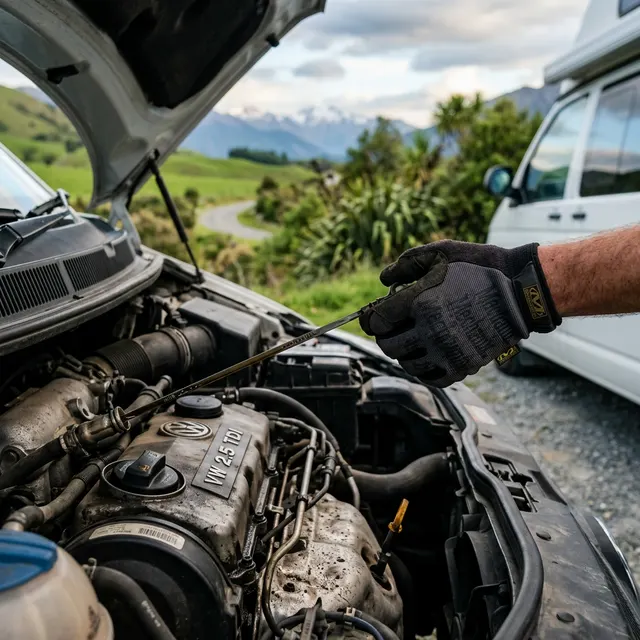
- Cap, dipstick, coolant — Inspect oil and coolant only when it is safe and follow the vehicle’s instructions. Never open a hot cooling system. Contamination, leaks or unexplained fluid loss need a mechanic’s diagnosis; an oil-cap deposit alone does not establish a failed head gasket.
- Ask the cambelt question — Identify the exact engine and whether it uses a belt or chain. Match maintenance invoices with the manufacturer’s schedule and ask the inspector to identify work due. Missing paperwork is not evidence that a replacement was done.
- Drive it like New Zealand drives — Agree a safe route with the seller and follow speed limits and conditions. Observe steering, braking, temperature and power at suitable speeds. Have unfamiliar noises, vibration or warning lights investigated rather than trying dangerous manoeuvres.
- Radio off, window half down — You're listening for whines, knocks and grinding — a soundtrack is the cheapest way to hide all three.
- Every gear, twice — Reverse included. Hesitation or crunching between shifts is gearbox money you'd be volunteering to spend.
📝 Good to know
Ask an independent inspector for a quote, the report’s scope and any limits on checking the camper conversion. The value of an inspection is not determined by a $5,000 purchase threshold. Obtain written findings and repair estimates before deciding.
The Camper Kit: Test, Don't Admire
A pretty build sells vans; a working build keeps trips alive
Fairy lights are lovely. Water pressure, cold beer and charged phones are lovelier. Test the systems like you already live in it.
- Certificate in hand, not in the ad — Check the actual certificate, expiry, green warrant card and national SCV register entry for this vehicle. The old blue warrant is no longer recognised from 7 June 2026. A promotional sticker does not prove certification.
- Water in, water out — Run the tap, watch the drain flow, then open the cupboard under the sink and press the wood. Soft timber remembers every past leak.
- Plug your phone into every socket — The fastest audit of a 12V system ever invented. Bring your own cable.
- Run the fridge and lights on the battery — Run appliances with the seller and note the battery type, capacity, age and charging arrangements. Ten minutes of operation does not establish battery health. Ask a suitable specialist to test capacity and installation if uncertain.
- Make 'it has solar' mean something — Ask for the panel wattage and the controller brand. Without numbers, 'solar' can mean a trickle charger and an optimistic sticker.
- Check gas safety with a qualified gasfitter — Ask for the gasfitting documentation and arrange a qualified gasfitter’s check if uncertain. WorkSafe says portable gas cookers, heaters and lanterns must not be used inside a caravan or motorhome, including awnings. If you smell gas, stop testing the equipment and follow official gas-safety advice.
- Lift the mattress — Brown rings on the plywood underneath are the honest autobiography of every roof leak the van has ever had.
Money and Paperwork: The Last Fifteen Minutes
- Check inspection and licence separately — Read the WoF issue date and expiry, and the rego status. Buyers can insist on a WoF less than one month old; record acceptance of an older or expired inspection as NZTA requires.
- Does RUC apply? Read the distance licence — Compare the purchased distance with the odometer for any RUC vehicle, not only diesel vans. Resolve a shortfall before paying: the new registered person may become responsible for outstanding charges.
- Write the sale record before paying — Record buyer and seller details, date, price, plate, VIN, included equipment, known faults and agreed conditions. Keep signed copies and evidence of payment. “Sold as seen” does not settle every dispute or remove statutory obligations.
- Notify NZTA at the handover — Buyer and seller each notify NZTA immediately. The buyer’s online transaction needs a New Zealand driver licence; otherwise use an agent and check identification requirements. The registered-person record is not proof of legal ownership.
- Confirm insurance before driving — Get terms for your own licence, age, trip and conversion before committing, and arrange the cover’s start time for handover. Application time and acceptance vary by insurer.
Reasons to Walk Away
None of these are negotiation openers
Treat unresolved identity, finance, safety or inspection problems as reasons to pause or walk away. Do not let a departure deadline replace verification.
🚩 If you meet one of these, leave
- ✅ You're not allowed to arrange an independent inspection — whatever the excuse
- ✅ The timeline is doing the selling ('two other buyers are coming at four')
- ✅ The seller's story doesn't line up with the CarJam ownership dates
- ✅ 'My mechanic mate already checked it' is offered instead of documents
- ✅ A special discount appears only if you pay cash today
- ✅ The VINs on the windscreen, door pillar and papers don't all match
📝 Good to know
Listings show seller-provided details. A CarJam link, where a plate is supplied, is a route to third-party checks; it does not mean Kiwi Van Market has verified the vehicle or paid for a full report.
FAQ
Should I bring someone to a van viewing?
If you can, yes. A second person watches the seller's reactions while you watch the van — and pressure tactics deflate fast in front of an audience. Solo? Phone a friend during the viewing and think out loud.
Is a cheap OBD2 scanner worth buying?
A compatible scanner can provide useful fault and readiness information, but coverage differs by vehicle and tool. Cleared codes or intermittent faults may not appear. A clean scan is not evidence that the engine or gearbox is sound; ask the inspector what diagnostics are appropriate.
How long should I allow for a proper viewing?
Ninety minutes minimum: fifteen standing back and walking around, thirty on systems and paperwork, thirty on the road, and buffer to think without pressure. Anyone rushing you through it is answering a question you didn't ask.
Is it normal to leave a deposit?
Only after an inspection you're satisfied with, only with a written receipt stating the amount and the conditions, and never to 'reserve' a van you haven't seen in person. For the balance, an in-person bank transfer beats cash — it writes its own receipt.